A Guide to Essential Technology for Off-the-Grid Adventure Travel
Going off-grid? Don't go unprepared. This is your guide to the essential tech that will keep you safe, powered up, and ready for anything the wild throws at you.

LAST UPDATED


LAST UPDATED
Whether you’re chasing waterfalls or hiking volcanoes, Journey eSIM gives you reliable data in 190+ countries—no bulky gadgets, just pure freedom.
The Adventure Seeker's Tech: Essential Gear for Off-the-Grid Exploration
There’s a powerful romance to the idea of going truly "off-the-grid." It’s a yearning to disconnect from the noise of our hyper-connected world and reconnect with something more primal and profound. It’s the smell of pine needles on a damp forest floor, the profound silence of a desert canyon at dusk, the humbling scale of a snow-capped mountain range against a brilliant blue sky. These are the experiences that call to the adventurer’s soul.
For a long time, the philosophy of such adventures was to leave all technology behind. A map, a compass, and your own wits were the only tools you needed. But the modern adventurer has a different, smarter philosophy. We understand that the right technology doesn't detract from the wilderness experience; it enhances it. It doesn’t chain you to civilization; it gives you the confidence to venture further and more safely into the wild.

This isn’t about checking your emails at the summit. This is about life-saving communication, fail-safe navigation, and sustainable power in places where there are no outlets and no cell towers. This is your guide to the essential tech that belongs in every serious adventurer’s pack—the gear that enables smart, safe, and truly epic solitude.
The Holy Trinity of Off-the-Grid Tech
When you step beyond the reach of civilization's infrastructure, your needs become very basic and very critical. Every piece of tech you carry must serve a purpose and be utterly reliable. The essential adventure kit can be broken down into three core pillars: Power, Communication, and Navigation.
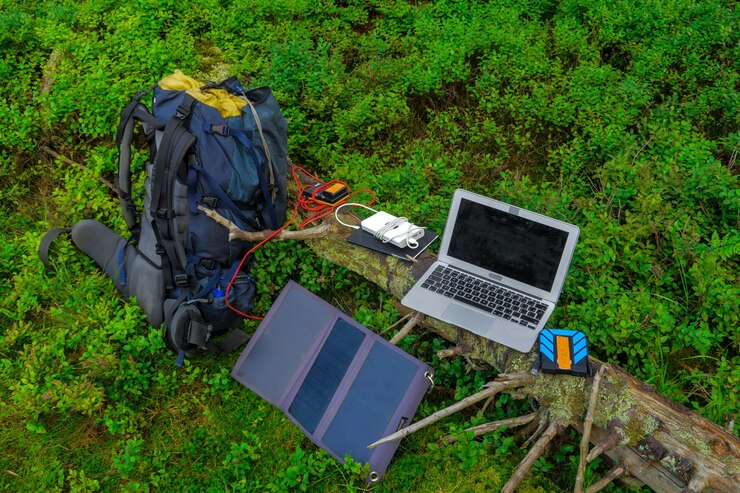
1. The Power Plant in Your Pack: Solar Power Banks
Your GPS, your headlamp, your camera, and your emergency phone are all useless bricks if their batteries are dead. In the wilderness, power is life. Since you can’t pack an infinite number of batteries, you need the ability to generate your own electricity.
What to Look For:
A Solar Power Bank is a portable battery pack with built-in photovoltaic panels. It’s your personal, pocket-sized power station. But not all are created equal.
-
Durability: Look for a unit that is at least IP65 rated, meaning it’s water-resistant and dust-proof. A rugged, shock-proof rubberized casing is a must. It needs to survive being dropped and rained on.
-
Capacity (mAh): Capacity is measured in milliampere-hours. A 10,000mAh battery is a good starting point, capable of charging a modern smartphone about twice. For longer trips, a 20,000-25,000mAh unit is a safer bet.
-
Panel Efficiency: Don't be fooled by tiny solar panels. A small panel will take days to recharge the battery fully. While you should always leave basecamp with the power bank itself fully charged, the solar panels are your emergency backup, trickle-charging the unit throughout the day as it hangs from your backpack.
Having a reliable power source means you can confidently use your GPS to navigate back to camp after dark or use your phone to take that once-in-a-lifetime photo without suffering from "battery anxiety."

2. The Lifeline to the World: Satellite Messengers
This is, without question, the most important piece of safety equipment an off-the-grid adventurer can carry. Cell phones work by communicating with nearby towers. When there are no towers, your phone is useless for communication. A satellite messenger works by communicating directly with satellites orbiting the Earth.
What to Look For:
Devices from brands like Garmin (with their inReach series) or SPOT are the industry standard. They offer a suite of life-saving features that work anywhere on the planet.
-
Two-Way Messaging: This is a game-changer. You can send and receive short text messages via satellite to any cell phone number or email address. This allows you to check in with family, let them know you’re okay, or inform them of a change in plans.
-
SOS Button: This is the feature you hope you never have to use, but will be eternally grateful for if you do. Pressing the SOS button sends a distress signal with your exact GPS coordinates to an international emergency response coordination center, which will then dispatch local search and rescue teams.
-
Location Tracking: These devices can automatically send out "pings" of your location at set intervals, allowing loved ones to follow your journey on a map from home, giving them (and you) immense peace of mind.
Twisting an ankle a few miles from the trailhead is an inconvenience. Twisting an ankle 20 miles into a remote backcountry trail with no way to call for help is a life-threatening emergency. A satellite messenger is the difference between those two scenarios. For a deep dive into the technology, outdoor retailers like [REI] offer excellent comparisons and guides.
3. The Un-Loseable Map & Indestructible Camera
While your smartphone is a powerful navigation tool, relying on it as your sole map in the deep wilderness can be risky due to battery life and fragility.
-
Dedicated GPS Device: A handheld GPS unit from a brand like Garmin is built for the wild. They are incredibly durable, waterproof, and have a much longer battery life than a phone. They provide highly accurate topographical maps and reliable location tracking that won't fail you in a critical moment.
-
Rugged Action Camera: Your new iPhone camera is amazing, but it’s not designed to be dropped on rocks or submerged in a river. An action camera like a GoPro or a waterproof point-and-shoot from a brand like Olympus is built to withstand the elements. It ensures you can capture the heart of your adventure—kayaking down rapids, mountain biking a muddy trail—without risking your primary communication device.

The Bridge Back to Civilization: Why Your eSIM is Your On-Ramp
The gear we’ve just discussed is designed for when you are well and truly off the grid. But no adventure exists in a vacuum. Every off-grid expedition has a beginning and an end—an "on-ramp" and an "off-ramp" that connect you back to the civilized world. This is where your connectivity strategy becomes crucial, and where the most important piece of travel tech comes into play.
Imagine you’ve just finished a grueling 5-day trek through the Patagonian wilderness. You’re exhausted, dirty, and exhilarated. You finally arrive in the small base town of El Chaltén. The first things you want to do are message your family that you're safe, find a hot shower, and book a proper bed for the night. This is not the time to be wandering around desperately searching for a cafe with decent Wi-Fi or trying to find a mobile shop that sells local SIM cards.
This is the moment a Journey eSIM proves its essential worth. It is the bridge.
Before you even left home, you could have installed a Journey eSIM for Argentina. The moment you walked into that small town and your phone picked up the faintest cell signal, you would have been instantly connected. You could have booked a hostel on your phone while walking down the main street.
The Journey eSIM is the tool that makes the transitions of your adventure seamless.
-
The Arrival: You land in a new country to start your adventure—say, Nepal for a trek to Everest Base Camp. Your Journey eSIM connects you the moment you land, so you can coordinate with your guide or navigate to your hotel in Kathmandu without any stress.
-
The Border Crossing: Many of the world’s greatest adventures involve crossing borders, like hiking between Argentina and Chile. With a Journey Global Plan, your eSIM automatically switches networks as you cross. No new SIMs, no dead zones.
-
The Triumphant Return: You finish your adventure. You want to upload that one epic summit photo or video call your loved ones to share the story. Your eSIM gives you the instant, high-speed data to do it, celebrating your achievement with the world in real-time.
An off-the-grid adventure requires a dual strategy. You need the satellite tech for the deep wild, and you need the cellular tech for the edges. A Journey eSIM is the most efficient, affordable, and modern way to handle the cellular side, ensuring you're connected right when you need it most—at the beginning and end of your wild journey.

Key Takeaways:
-
Modern off-the-grid adventures are not about abandoning technology, but about using smart, purpose-built tech to enhance safety and experience.
-
The three pillars of essential off-grid gear are a durable solar power bank for power, a satellite messenger for life-saving communication, and a dedicated GPS for reliable navigation.
-
While this gear is for when there is no cell signal, a seamless connectivity strategy for the "on-ramp" and "off-ramp" of your adventure is equally critical.
-
A Journey eSIM is the perfect tool for this, providing instant, affordable data upon arrival in a country, at the end of a trail, or when crossing borders.
-
Combining off-grid satellite tech with a flexible cellular eSIM plan creates a comprehensive, modern, and safe approach to adventure travel.
Conclusion:
The call of the wild is a powerful one. Answering it doesn't mean you have to be reckless. By equipping yourself with the right technology, you’re not diminishing the adventure; you’re enabling it. You’re giving yourself a safety net that allows you to push your boundaries with confidence. You’re ensuring that you have the power to navigate, the ability to call for help, and the means to seamlessly reconnect with the world when your journey is done. So pack smart, choose the right tools, and go find the solitude and adventure your soul is searching for.
Need some time to finalise your holiday plans? Share your email to get deals for your next Journey delivered to your inbox

